
New Build vs Established Property: Which Is the Better Investment in 2026?

An image of both a new build property and an established property side by side.
The 2026 Federal Budget changed the answer to one of property investing's most debated questions. For investors buying after Budget night on 12 May 2026, new builds and established properties now sit in fundamentally different tax positions. That changes the comparison in ways that matter significantly to your long-term returns.
This article runs both options side by side across every factor that actually matters: purchase price, rental yield, depreciation, negative gearing, capital gains tax, build risk, cashflow, and long-term strategy. By the end, you will have a clear framework for deciding which is right for your situation.
What Has Actually Changed Since the Budget?
Before the comparison, the single most important thing to understand is this: the Budget did not change the rules for everyone. It changed the rules for investors buying established property after Budget night.
Here is the summary:
For new builds purchased after Budget night, full negative gearing is retained. Investors can still offset losses against wages and salary. On capital gains, new build investors get to choose between the existing 50% CGT discount or the new inflation-adjusted regime, whichever produces the better outcome for their situation.
For established properties purchased after Budget night, losses can still be deducted but only against residential property income from 1 July 2027. They can no longer be offset against wages. Any excess loss carries forward to future property income or capital gains.
For properties purchased before Budget night, nothing changes. Existing portfolios are fully grandfathered.
This asymmetry is the lens through which every other comparison in this article needs to be read.
Purchase Price and Entry Cost
New build: New builds typically carry a premium over equivalent established properties in the same suburb. You are paying for a brand new product, a builder's margin, and in many cases the developer's profit. In Perth and most other capital cities, a new build will generally cost 10 to 20% more than a comparable established property in the same area.
Established property: Lower entry price is one of the most compelling arguments for established property. You are buying an existing asset at market value, negotiated between a willing buyer and a willing seller, with no developer margin embedded in the price. This means your deposit goes further, your loan is smaller, and your cashflow position starts from a better base.
Verdict: Established property wins on entry cost. But entry cost is only one line in the investment equation.
Rental Yield
New build: New builds generally achieve strong rental yields because tenants are willing to pay a premium for modern fixtures, energy efficiency, and low maintenance. In Perth's current market, well-located new builds are achieving gross yields of 4.5 to 5.5% depending on property type and suburb.
Established property: Yields on established properties vary significantly depending on age, condition, and location. Older properties in high-demand rental markets can achieve competitive yields, but ongoing maintenance costs and the absence of depreciation benefits erode the net return over time.
Verdict: Broadly comparable, with a slight edge to new builds on net yield once depreciation and maintenance are factored in.
Depreciation
This is one of the most significant and most overlooked differences between the two options.
New build: Every component of a new build, the structure, the fittings, the appliances, the flooring, the hot water system, depreciates from day one. A quantity surveyor's depreciation schedule on a new build typically generates $8,000 to $15,000 or more in annual deductions in the early years of ownership. This directly reduces your taxable income and improves your cashflow position.
Established property: Depreciation entitlements on established properties are limited. Since the 2017 federal budget changes, investors who purchase a second-hand residential property can no longer claim depreciation on the plant and equipment assets that were part of the property at purchase. You can still claim capital works deductions on the building structure if it was built after 1985, but the total annual deduction is a fraction of what a new build delivers.
Verdict: New build wins decisively. The depreciation advantage alone can be worth thousands of dollars per year in tax savings, which effectively subsidises your holding costs and improves your real cashflow position.
Negative Gearing
This is where the 2026 Budget has the most direct impact on the comparison.
New build: Full negative gearing is retained. If your new build generates a loss, you can offset that loss against your wages and salary, reducing your income tax bill. For a high-income earner paying the top marginal rate, every dollar of deductible loss saves 47 cents in tax. This is the same treatment investors have always had and it continues unchanged for new construction.
Established property (purchased after Budget night): From 1 July 2027, losses on established properties purchased after Budget night are ring-fenced to residential property income. They cannot offset wages. An investor earning $150,000 in salary and holding a negatively geared established property purchased after Budget night will no longer receive the annual income tax benefit they would have previously. The loss carries forward, but the immediate cashflow benefit is gone.
Verdict: New build wins clearly under the post-Budget rules. For established property buyers after Budget night, the negative gearing advantage has been materially reduced.
Capital Gains Tax
New build: New build investors can choose between the existing 50% CGT discount or the new inflation-adjusted regime with a minimum 30% tax rate from 1 July 2027. The ability to choose the better outcome depending on their situation is a meaningful structural advantage that established property buyers after Budget night do not have.
Established property (purchased after Budget night): The 50% CGT discount is removed for assets acquired after 1 July 2027 and replaced with the inflation-adjusted model and minimum 30% tax. For investors planning to sell within a 5 to 15 year window, the impact on after-tax profit at sale is real and needs to be modelled.
Established property (purchased before Budget night): Fully grandfathered. The 50% discount remains available on a future sale.
Verdict: New build wins on CGT flexibility. Grandfathered established property is unaffected.
Cashflow
Cashflow is the weekly and monthly reality of owning an investment property. It is the difference between what the property costs to hold and what it earns.
New build: Higher purchase price means a larger loan and higher interest repayments. However, this is offset by stronger rental yield, significant depreciation deductions, and the full negative gearing tax benefit. The real out-of-pocket weekly cost of holding a well-chosen new build for a high-income earner is often lower than the headline numbers suggest once tax is factored in.
Established property: Lower purchase price means a smaller loan and lower headline repayments. But the absence of significant depreciation, the reduced tax benefit from ring-fenced negative gearing post-Budget, and higher ongoing maintenance costs mean the actual net cashflow position is tighter than it used to be for new purchases after Budget night.
Verdict: Comparable on headline figures, but new build wins on real net cashflow once depreciation and the post-Budget tax treatment are factored in for established properties bought after 12 May 2026.
Build Risk and Timeline
This is where established property holds a genuine advantage that should not be dismissed.
New build: Buying a new build off the plan or during construction introduces risks that purchasing an existing property does not. Builder insolvency is a real risk in the current construction environment. Cost overruns, delays, and variations can affect both timeline and final value. A property purchased off the plan today at a set price may be worth less at completion if the market has moved. You also do not receive rental income until the build is complete.
Established property: You buy it, you settle it, you rent it. The asset exists. You can inspect it, value it, and rent it from day one. There is no construction timeline, no builder relationship to manage, and no risk of the product not being what was represented.
Verdict: Established property wins on risk and simplicity of execution. New builds require more due diligence on the builder, the contract, and the fixed-price terms.
Long-Term Capital Growth
New build: New builds in well-chosen locations perform comparably to established properties over long hold periods. The premium paid at purchase is the key variable. If you overpay for a new build in a high-supply area, the growth outlook is weaker. If you buy a new build in a constrained market with genuine demand drivers, the long-term growth case is strong.
Established property: Established properties in quality locations with genuine scarcity have historically delivered strong long-term capital growth. The land component is typically a larger proportion of the total value, which is where long-term growth is generated.
Verdict: Broadly comparable over long hold periods, with location and land content being more important predictors of growth than whether the property is new or established.
The Side-by-Side Summary
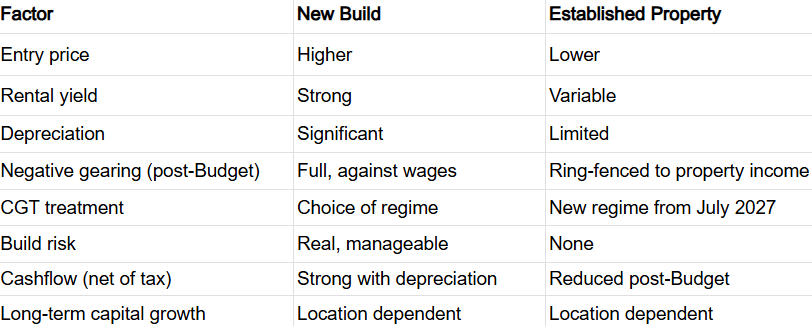
So Which One Is Right for You?
The honest answer is that it depends on your situation, your goals, and your timeline. But here is a clear framework.
Choose a new build if: you are buying after Budget night, you are a high-income earner who wants to maximise tax efficiency, you want the depreciation benefit from day one, you are comfortable with the construction timeline and want to hold for 7 years or more.
Choose established property if: you purchased before Budget night and are reviewing a new acquisition using available equity, you want simplicity and immediate rental income, you have found a genuine value opportunity in a constrained market with strong yield, and you have modelled the post-Budget cashflow position carefully with your accountant.
Do not choose either based on emotion. Do not choose a new build just because it looks impressive or an established property just because the purchase price is lower. Every decision should be backed by a feasibility that accounts for purchase costs, rental income, holding costs, depreciation, tax treatment, and a realistic exit scenario.
What About Property Development?
For investors who want new build tax advantages but also want to capture the uplift in value that comes from creating the asset rather than just buying it, property development sits above both options on the return spectrum.
Motivate Property Group's development service manages the entire process done for you, from feasibility through to handover. Target returns of 15 to 20% on total project value, with 50 to 100% return on capital invested within 24 to 36 months. The tax treatment mirrors new build investment, with full negative gearing retained and favourable CGT treatment.
If you are already considering a new build investment, it is worth understanding whether development is within reach for your situation before committing to a standard purchase.
The rules have changed. The opportunity has not.
Whether a new build or established property is the right move for you comes down to one thing: what the numbers actually look like for your specific situation, your income, your borrowing capacity, and your timeline.
That is exactly what our team is here to work through with you. No generic advice. No one-size-fits-all recommendation. Just a clear picture of which path makes the most sense for where you are right now. Book your free conversation here.